UNDERSTANDING
COPD
DIAGNOSIS OF COPD
COPD SCREENING TEST
Diagnosis
Many people have early-stage COPD but are not yet aware of it, and they are therefore not proactively protecting their lungs from further damage. Up to 7 in every 10 people who experience persistent breathing issues have never been diagnosed. 15
No matter your age, if you have any of the risk factors for developing COPD, speak to your doctor today to have your lung function tested, even if you do not yet experience symptoms.
There are a few tell-tale signs that you may be suffering from COPD that you need to look out for. If you experience one or more of these signs, it is strongly recommended that you ask a doctor to check your lung function. 12
Struggling to breathe
Getting lower respiratory infections (chest colds) often
A cough
that may come and go, with or without phlegm
Wheezing
that comes and goes
Exposure
to any of the elements listed below
Struggling to breathe
Getting lower respiratory infections (chest colds) often
A cough
that may come and go, with or without phlegm
Wheezing
that comes and goes
Exposure
of the elements listed below:
- Tobacco smoke, vaping or hookah
- Smoke from home cooking or heating fuels
- Occupational (work-related) dust, vapour, fumes, gases and chemicals
Having a family history of COPD, being born prematurely or with low birthweight, or having had many childhood respiratory infections (such as the common cold or chest colds)
- Tobacco smoke, vaping or hookah
- Smoke from home cooking or heating fuels
- Occupational (work-related) dust, vapour, fumes, gases and chemicals
- Having a family history of COPD, being born prematurely or with low birthweight, or having had many childhood respiratory infections (such as the common cold or chest colds)
Testing
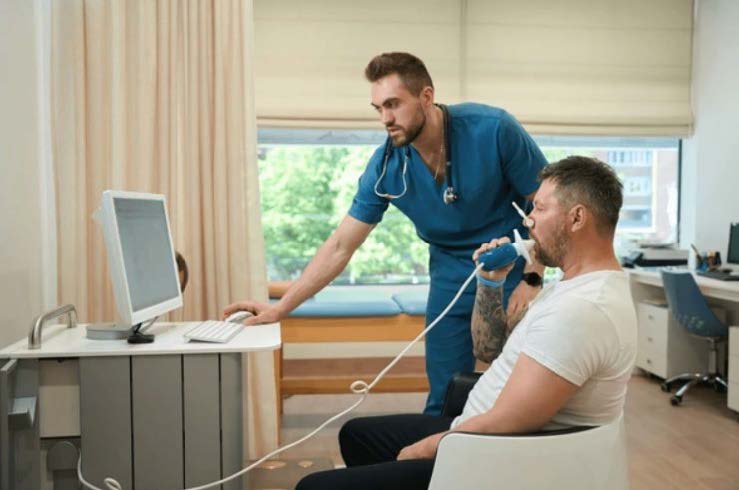
Spirometry test
| Forced vital capacity (FVC) | Forced expiratory volume – one second (FEV1) | The FEV1/FVC ratio (FEV1%) |
| Measures your lung size (in litres) and represents the air volume in the lungs that can be exhaled following a deep inhalation. | Measures how much air can be exhaled in one second following a deep inhalation. |
Represents the percentage of your lung size (FVC) that you can exhale in one second. For example, if the FEV1 is 4 and the FVC is 5, the FEV1/FVC ratio would be ⅘ or 80%, which means you can breathe out 80% of the inhaled air in your lungs in one second. Generally speaking, a healthy FEV1% for adults is above 70%, while a healthy FEV1% for children is 80–85%. |
Other tests
Find out more
About COPD and its symptoms
Chronic Obstructive Pulmonary Disease (COPD) is a term that involves two conditions called chronic bronchitis (bron-ki-tis) and emphysema. A person could have only one or both of these conditions at the same time.8
COPD causes and risk factors
COPD is a preventable condition, and the first step in keeping your lungs healthy is to know what the most likely causes are. 8